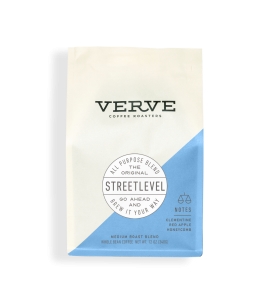
Verve Coffee Streetlevel
Red fruit leads, milk chocolate catches at the finish, and the cup stays sweet regardless of brew method.
Profile
Tasting Notes
- Hot, the East Africa component takes the lead: a tart red fruit note, cranberry-adjacent, with a clean edge that holds distinctly above 160°F.
- As the cup cools, the sweetness climbs and the acidity settles back; milk chocolate and brown sugar move forward, and the cup shifts from bright to round.
- Bitterness stays absent across the full extraction range. pour over, drip, and espresso all finish with sweetness as the dominant aftertaste.
- In espresso, brown sugar concentrates at the core; the red fruit note survives short pulls but fades if the shot runs long.
- Body is present and consistent throughout, enough to carry the flavors without weighing the cup down.
Who It’s For
Morning drinkers who want something bright enough to feel like it's doing something but sweet enough to finish without edge. the kind of cup that sits beside breakfast and asks nothing of you. It also works well for someone pulling espresso on a mid-range machine who wants cooperative shots without calibration overhead.
As a blend, neither the Latin American nor the East African origin tells a complete story. The cup is assembled for functional consistency, and a drinker looking for the distinct character of a specific lot from either region will come away underserved. At Verve's typical specialty-tier pricing for a 12-oz bag, you are paying for the roaster's sourcing infrastructure and quality control, and the most distinctive lots in that infrastructure go to the single-origin lineup, not here.
Full review
Streetlevel is a deliberate construction. Verve draws from Latin America and East Africa for this blend, both sides processed through the washed method, which removes fermentation residue from the seed before drying. That choice keeps the flavors clean and separate. The Latin American component brings structure: chocolate, brown sugar, a sweetness foundation. The East African component brings acidity and red fruit lift. Both register in the cup, and neither tips the blend off its axis.
The sensory numbers bear this out in a way that matters practically. Acidity at 4/5 means the brightness is real and forward at temperature, not background texture. Sweetness at 4/5 means the finish stays agreeable through the whole cup. Bitterness at 1/5 means even if your brew runs a few degrees hot, the result does not turn harsh. For a medium-roast blend designed to work across three very different extraction methods, that combination is more carefully calibrated than it first appears. The 3/5 roast intensity is the signal: the roast is kept restrained specifically to preserve the East African acidity and the Latin American sweetness that would flatten at a darker stop.
In drip and pour over, the profile tracks predictably. The first few sips at high temperature are fruit-forward and defined. As the cup cools into the 130-140°F range, the red fruit steps back and the milk chocolate comes up. The cup holds its character through that transition whether you brewed carefully or casually, because the temperature tolerance is wide for a blend with this level of acidity. Tandem Coffee's Time and Temperature is built on a similar design logic. assembling components for flavor continuity as the extraction arc plays out, so the cup you sip last tastes like the cup you sip first. Streetlevel functions the same way; both hemispheres remain readable from the first pour to the last cool swallow.
For espresso, Streetlevel behaves predictably. Short pulls keep the red fruit note alive and yield a sweet, dense shot that works alongside milk in a flat white or cortado. Illy Classico sets the benchmark for this category: a performance-focused medium-roast espresso that works across machines, requires no dialing, and never punishes the brewer. Streetlevel matches that accessibility and adds more defined acidity where Illy Classico delivers a rounder, body-forward consistency. The trade-off is real: in milk-heavy drinks, a denser body carries through steam more effectively, and Streetlevel's 3/5 body does not dominate the cup the way Illy's does. Black or pulled short, Streetlevel has the clearer flavor definition.
The value question with Verve's blends is consistent: the overhead of direct sourcing relationships is built into the price, which is defensible for a single-origin lot but harder to justify for a house blend. The distinctive harvest lots go to the single-origin lineup. Streetlevel gets the consistent, reliable components. well-sourced and well-roasted, but assembled for repeatability. The cup is good. The sensory profile is not an accident. But the price includes a significant brand premium, and a well-sourced medium blend from a less-established roaster at a lower price point can approximate the experience in ways that are harder to dismiss than the specialty-roaster branding suggests.
The pour over is where the design intent is clearest. Acidity and sweetness reach equilibrium without any adjustment on the brewer's end, and the cup holds that character as it cools. Brew it at 196°F with a medium-fine grind and it lands exactly where the sensory numbers predict.
Keep pulling the thread: Medium roast guide, Latin America, East Africa blend origin guide, and more from Verve Coffee Roasters.
Price & History
Streetlevel ships in a 12-oz bag at Verve's specialty-tier pricing, which places it at the higher end of what the market charges for a house medium blend from an established West Coast roaster.
► Show price history (38 days)
| Date | Price | Per oz |
|---|---|---|
| Jul 26, 2026 | $22.00 | $1.833 |
| Jul 25, 2026 | $22.00 | $1.833 |
| Jul 24, 2026 | $22.00 | $1.833 |
| Jul 23, 2026 | $22.00 | $1.833 |
| Jul 22, 2026 | $22.00 | $1.833 |
| Jul 21, 2026 | $22.00 | $1.833 |
| Jul 20, 2026 | $22.00 | $1.833 |
| Jul 19, 2026 | $22.00 | $1.833 |
| Jul 18, 2026 | $22.00 | $1.833 |
| Jul 17, 2026 | $22.00 | $1.833 |
| Jul 16, 2026 | $22.00 | $1.833 |
| Jul 15, 2026 | $22.00 | $1.833 |
| Jul 14, 2026 | $22.00 | $1.833 |
| Jul 13, 2026 | $22.00 | $1.833 |
| Jul 12, 2026 | $22.00 | $1.833 |
| Jul 11, 2026 | $22.00 | $1.833 |
| Jul 10, 2026 | $22.00 | $1.833 |
| Jul 9, 2026 | $22.00 | $1.833 |
| Jul 8, 2026 | $22.00 | $1.833 |
| Jul 7, 2026 | $22.00 | $1.833 |
| Jul 6, 2026 | $22.00 | $1.833 |
| Jul 5, 2026 | $22.00 | $1.833 |
| Jul 4, 2026 | $22.00 | $1.833 |
| Jul 3, 2026 | $22.00 | $1.833 |
| Jul 2, 2026 | $22.00 | $1.833 |
| Jul 1, 2026 | $22.00 | $1.833 |
| Jun 30, 2026 | $22.00 | $1.833 |
| Jun 29, 2026 | $22.00 | $1.833 |
| Jun 28, 2026 | $22.00 | $1.833 |
| Jun 27, 2026 | $22.00 | $1.833 |
| Jun 26, 2026 | $22.00 | $1.833 |
| Jun 25, 2026 | $22.00 | $1.833 |
| Jun 24, 2026 | $22.00 | $1.833 |
| Jun 23, 2026 | $22.00 | $1.833 |
| Jun 22, 2026 | $22.00 | $1.833 |
| Jun 21, 2026 | $22.00 | $1.833 |
| Jun 14, 2026 | $22.00 | $1.833 |
| Jun 13, 2026 | $22.00 | $1.833 |
Rating
FAQ
What does Verve Coffee Streetlevel taste like?
Hot, the East Africa component takes the lead: a tart red fruit note, cranberry-adjacent, with a clean edge that holds distinctly above 160°F. As the cup cools, the sweetness climbs and the acidity settles back; milk chocolate and brown sugar move forward, and the cup shifts from bright to round. Bitterness stays absent across the full extraction range. pour over, drip, and espresso all finish with sweetness as the dominant aftertaste.
Who is Verve Coffee Streetlevel best for?
Morning drinkers who want something bright enough to feel like it's doing something but sweet enough to finish without edge. the kind of cup that sits beside breakfast and asks nothing of you. It also works well for someone pulling espresso on a mid-range machine who wants cooperative shots without calibration overhead.
Who should skip Verve Coffee Streetlevel?
As a blend, neither the Latin American nor the East African origin tells a complete story. The cup is assembled for functional consistency, and a drinker looking for the distinct character of a specific lot from either region will come away underserved. At Verve's typical specialty-tier pricing for a 12-oz bag, you are paying for the roaster's sourcing infrastructure and quality control, and the most distinctive lots in that infrastructure go to the single-origin lineup, not here.