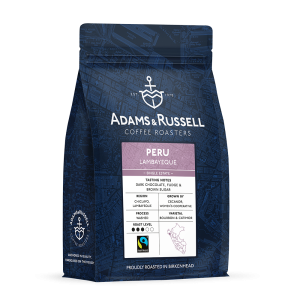
Adams & Russell Papua New Guinea Mountain Top
The medium roast pulls the Chimbu sweetness to the front and trades away the brightness that a lighter hand would have kept.
Affiliate link. We earn a commission at no extra cost to you.
Profile
Tasting Notes
- As the cup cools, dried fruit lifts forward: raisin first, then a faint grape softness underneath the cocoa-powder warmth that leads the first sip.
- Sweetness is the dominant register throughout, staying consistent from first pour to the end of the cup; the malt base prevents the finish from drying.
- Bitterness holds low (2/5) even as extraction runs long, which gives home brewers more margin than most medium-roast single origins allow.
- Nutmeg appears mid-palate in pour over, brief and dry, grounding the profile in something distinctly Highlands.
- Blackberry reads clearly in filter brews; french press immersion softens it toward a generic dark grape and loses the definition.
Who It’s For
Pour over and drip setups where you want a sweet, low-bitterness cup with enough origin character to feel like a specific coffee, not a category placeholder. The forgiving extraction suits home brewers who don't dial in precisely.
The blackberry is essentially gone in french press: what remains is a generic dark grape that carries none of the Chimbu specificity, so immersion drinkers who want distinct fruit character will find the cup does not deliver what the pour-over profile promises. The price data is also thin at one check in 30 days, so there is no track record to confirm $11.00 is the floor.
Full review
In drip and pour over, the Papua New Guinea Mountain Top performs consistently. The extraction tolerates variance: grind coarser or finer than your usual medium-roast starting point and the cup adjusts without going sour at one end or moving bitter at the other. That adaptability comes from where the roast sits. At medium with a 3/5 roast intensity, the sugars have developed without the roast consuming them, which keeps sweetness available across the full extraction rather than concentrating it at a single temperature or ratio.
Chimbu Province sits at altitude in Papua New Guinea's central highlands. Coffee grown here has more time on the tree than lowland lots, and that slow cherry development is what builds the malt backbone and dried-fruit character this bean carries into the cup. The washed process, applied post-harvest, reduces the fermentation-driven earthiness that natural PNG coffees can carry and lifts the clarity of the core notes: cocoa-powder warmth up front, raisin and a faint grape underneath, and the nutmeg dryness at mid-palate that marks it as a Highlands coffee. The acidity lands at moderate (3/5), present but not defining, so the cup stays readable without being sharp.
French press changes the experience. Immersion softens the fruit, so the blackberry loses its distinction and settles into a generalized dark grape. The nutmeg retreats; the malt fills more of the cup. The 4/5 sweetness holds across both methods, and the low bitterness stays stable, but the specificity that makes pour over feel like a named single origin is gone in immersion. What remains is pleasant without being precise.
Against Volcanica Coffee's Kona Peaberry on flavor profile, the comparison clarifies what this cup is doing. Both are sweetness-forward, low-bitterness coffees with moderate body. The difference is the source of the sweetness: Kona Peaberry's comes from Hawaiian volcanic terroir and reads as clean and mildly nutty, close to a fresh quality. This PNG's sweetness comes from altitude-driven malt and dried fruit, so it reads warmer and sits lower in the palate. One is precise; this one is substantive. Neither is aggressive, which is the common ground.
Against the New England Coffee Blue Mountain Blend on performance, the Mountain Top lands in the same tier. The Blue Mountain Blend is built for reliability: low risk, consistent output, accessible across most home setups. The Mountain Top behaves the same way. Meticulous technique does not produce a dramatically better result, and imprecise technique does not collapse the cup. For a drinker who wants consistent sweetness and low bitterness without managing extraction variables, both deliver. The distinction is provenance: this is a named single origin with a verified growing region; the blend is engineered consistency.
At $0.92/oz for a Fairtrade-certified Chimbu Province single origin, the price is competitive. Single-origin specialty mediums from Highlands origins with this sweetness profile typically cost more without a proportionally better cup. The pricing has not moved in the available data window, which limits confidence in the floor but also suggests stability at an accessible level. There is no lower entry point on the chart to wait for.
What keeps the score where it is: the sweetness is the cup's one concrete distinction, and it is a real one. The Chimbu Province origin has quality credentials. But the acidity and body both land at moderate (3/5 each), the roast intensity is measured rather than expressive, and the fruit character is pleasant without being specific enough to hold memory. The cup earns its score on sweetness and honest pricing; past that, the profile does not add.
Keep pulling the thread: Medium roast guide, Papua New Guinea, Chimbu Province origin guide, and more from Adams & Russell.
Price & History
The price has held at $11.00 through the available window, with one check in 30 days and no movement. At $0.92/oz for 12 oz of Fairtrade-certified Chimbu Province single origin, the price is competitive for the specialty tier. No lower entry point exists in the data, and no seasonal movement is visible to wait on: buy it when you need it. The thin data record is the honest caveat.
Price history coming soon — check back after the next daily update.
Rating
FAQ
What does Adams & Russell Papua New Guinea Mountain Top taste like?
As the cup cools, dried fruit lifts forward: raisin first, then a faint grape softness underneath the cocoa-powder warmth that leads the first sip. Sweetness is the dominant register throughout, staying consistent from first pour to the end of the cup; the malt base prevents the finish from drying. Bitterness holds low (2/5) even as extraction runs long, which gives home brewers more margin than most medium-roast single origins allow.
Who is Adams & Russell Papua New Guinea Mountain Top best for?
Pour over and drip setups where you want a sweet, low-bitterness cup with enough origin character to feel like a specific coffee, not a category placeholder. The forgiving extraction suits home brewers who don't dial in precisely.
Who should skip Adams & Russell Papua New Guinea Mountain Top?
The blackberry is essentially gone in french press: what remains is a generic dark grape that carries none of the Chimbu specificity, so immersion drinkers who want distinct fruit character will find the cup does not deliver what the pour-over profile promises. The price data is also thin at one check in 30 days, so there is no track record to confirm $11.00 is the floor.