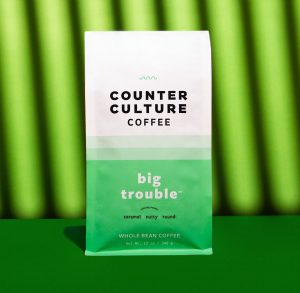
Counter Culture Big Trouble
Caramel sweetness from the first sip, a suggestion of fruit through the middle, and a finish that drops without dragging anything bitter with it.
Affiliate link. We earn a commission at no extra cost to you.
Profile
Tasting Notes
- Moderate acidity at the entry (3/5): present enough to lift the cup, not sharp enough to lead it
- Caramel owns the mid-palate, built from medium-roast development on a naturally sweet Honduras base; toffee registers a few degrees cooler
- Mild fruit sits behind the caramel as a softening agent rather than a distinct note; most legible in a slow pour over, background in drip
- Bitterness at 2/5 lets the sweetness finish uncontested; the cup fades on caramel, not on a dry edge
- Body holds the middle (3/5): enough presence to give espresso something to work with, light enough to stay unobtrusive in filter
Who It’s For
Drip and pour-over drinkers who've been burned by over-roasted grocery blends but aren't chasing single-origin precision. The 2/5 bitterness means the caramel sweetness reads through clearly on every cup, with no roast edge cutting across the finish.
At $1.63/oz, the price puts this in specialty territory, and the cup doesn't answer with distinctive origin character. Drinkers who want something concrete to point to in the flavor profile beyond caramel sweetness will find better arguments for the price from roasters offering more transparent single-lot sourcing.
Full review
The roast decision behind Big Trouble is restraint. At medium with 3/5 roast intensity, Counter Culture stops before the caramel sugars convert further into bittersweet territory. That leaves sweetness at 4/5 as the loudest thing in the cup, with bitterness held at 2/5 so nothing competes with it. Ecuador and Honduras, both processed washed, contribute clean sweetness over fermented complexity. Counter Culture amplifies that signal instead of burying it under roast character.
The structure in the cup follows directly from those choices. Caramel up front, toffee settling in as the temperature drops a few degrees, and mild fruit sitting behind both as a softening element rather than a third flavor. The acidity at 3/5 provides just enough lift at the entry to keep the sweetness from going flat. Fruit at the level this blend carries isn't something you'll chase; it's what prevents the mid-palate from reading as a single note repeated. This is the signature of a seasonal blend built for repeatability over distinction: the Ecuador and Honduras lots were chosen because washed processing at these origins produces a consistent, predictable sweetness profile year-round. That consistency is the product.
Across the three stated brew methods, the cup does different things. Drip is the most forgiving format: the moderate body holds up to minor grind inconsistency without collapsing thin, and the low bitterness means even a slightly over-extracted batch won't punish you. Pour over, run slower and a few degrees cooler than you'd use for a light roast, gives the fruit the best chance to surface, and the extra clarity of the method makes the caramel-toffee character more defined. Espresso is where the low bitterness becomes the most relevant feature. There's real extraction margin before the shot turns harsh, which is not something most specialty-tier medium blends offer at home. The shot won't be dense or thick — the body at 3/5 doesn't support that — but the sweetness reads clearly at the back of the tongue after the pull, and the cup doesn't demand milk to hide anything.
Eight O'Clock Original is a useful performance reference. At roughly a third of the price per ounce, Eight O'Clock delivers a serviceable medium: consistent, decent in drip, bitterness high enough to give the finish a blunt edge. Big Trouble outperforms it on sweetness clarity and bitterness control. The gap is meaningful in pour over, where the lower bitterness and higher sweetness have room to read separately. In drip it narrows, though the finish is still noticeably cleaner on the Counter Culture side. Stumptown Hair Bender covers overlapping flavor territory — caramel, chocolate, fruit — with more acidity and a heavier body that gives it more range across brew temperatures. Big Trouble gives up that texture for a profile that's sweeter and less demanding. It's a narrower flavor picture, and which one earns the price depends entirely on what the buyer is optimizing for.
The value question is where opinion legitimately splits. At $19.50 for 12 oz, the price tag reflects Counter Culture's positioning as a specialty roaster: the sourcing is credible, the roasting precision is evident in how consistently the sweetness comes through without scorching. What the price is not buying is single-lot transparency or origin character that distinguishes this cup from a well-built commercial blend. The seasonal sourcing from Ecuador and Honduras delivers consistency within a calibrated range, not the kind of variability that signals something remarkable happened at origin. For a returning buyer, that consistency is the point. For someone discovering the blend fresh, it may read as a gap between the brand's reputation and what's in the cup.
A shot pulled at moderate extraction gives you caramel sweetness without the acrid edge that pushes home espresso drinkers toward adding milk to fix the cup.
Keep pulling the thread: Medium roast guide, Ecuador, Honduras blend (seasonal) origin guide, and more from Counter Culture Coffee.
Price & History
The price has held flat at $19.50 for every check in the last 30 days, and with only two data points, there's no trend to read. This is the price. At $1.63/oz for a 12 oz bag, it's mid-range specialty pricing with no discount movement. If you want this blend, buy it now; there's no signal that waiting improves the deal.
► Show price history (38 days)
| Date | Price | Per oz |
|---|---|---|
| Jul 26, 2026 | $19.50 | $1.625 |
| Jul 25, 2026 | $19.50 | $1.625 |
| Jul 24, 2026 | $19.50 | $1.625 |
| Jul 23, 2026 | $19.50 | $1.625 |
| Jul 22, 2026 | $19.50 | $1.625 |
| Jul 21, 2026 | $19.50 | $1.625 |
| Jul 20, 2026 | $19.50 | $1.625 |
| Jul 19, 2026 | $19.50 | $1.625 |
| Jul 18, 2026 | $19.50 | $1.625 |
| Jul 17, 2026 | $19.50 | $1.625 |
| Jul 16, 2026 | $19.50 | $1.625 |
| Jul 15, 2026 | $19.50 | $1.625 |
| Jul 14, 2026 | $19.50 | $1.625 |
| Jul 13, 2026 | $19.50 | $1.625 |
| Jul 12, 2026 | $19.50 | $1.625 |
| Jul 11, 2026 | $19.50 | $1.625 |
| Jul 10, 2026 | $19.50 | $1.625 |
| Jul 9, 2026 | $19.50 | $1.625 |
| Jul 8, 2026 | $19.50 | $1.625 |
| Jul 7, 2026 | $19.50 | $1.625 |
| Jul 6, 2026 | $19.50 | $1.625 |
| Jul 5, 2026 | $19.50 | $1.625 |
| Jul 4, 2026 | $19.50 | $1.625 |
| Jul 3, 2026 | $19.50 | $1.625 |
| Jul 2, 2026 | $19.50 | $1.625 |
| Jul 1, 2026 | $19.50 | $1.625 |
| Jun 30, 2026 | $19.50 | $1.625 |
| Jun 29, 2026 | $19.50 | $1.625 |
| Jun 28, 2026 | $19.50 | $1.625 |
| Jun 27, 2026 | $19.50 | $1.625 |
| Jun 26, 2026 | $19.50 | $1.625 |
| Jun 25, 2026 | $19.50 | $1.625 |
| Jun 24, 2026 | $19.50 | $1.625 |
| Jun 23, 2026 | $19.50 | $1.625 |
| Jun 22, 2026 | $19.50 | $1.625 |
| Jun 21, 2026 | $19.50 | $1.625 |
| Jun 14, 2026 | $19.50 | $1.625 |
| Jun 13, 2026 | $19.50 | $1.625 |
Rating
FAQ
What does Counter Culture Big Trouble taste like?
Moderate acidity at the entry (3/5): present enough to lift the cup, not sharp enough to lead it Caramel owns the mid-palate, built from medium-roast development on a naturally sweet Honduras base; toffee registers a few degrees cooler Mild fruit sits behind the caramel as a softening agent rather than a distinct note; most legible in a slow pour over, background in drip
Who is Counter Culture Big Trouble best for?
Drip and pour-over drinkers who've been burned by over-roasted grocery blends but aren't chasing single-origin precision. The 2/5 bitterness means the caramel sweetness reads through clearly on every cup, with no roast edge cutting across the finish.
Who should skip Counter Culture Big Trouble?
At $1.63/oz, the price puts this in specialty territory, and the cup doesn't answer with distinctive origin character. Drinkers who want something concrete to point to in the flavor profile beyond caramel sweetness will find better arguments for the price from roasters offering more transparent single-lot sourcing.