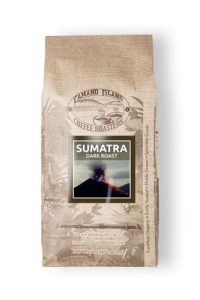
Camano Island Coffee Roasters Sumatra
The roast decision here runs Sumatra's Giling Basah earthiness to maximum intensity, delivering serious body and dark-chocolate weight while compressing the cedar origin character into a secondary note.
Affiliate link. We earn a commission at no extra cost to you.
Profile
Tasting Notes
- Acidity is essentially absent. You get no lift, no brightness, just flat ground-level weight from the first sip. For some drinkers that is the entire point; for others it is a ceiling on what the cup can do.
- Cedar surfaces mid-cup, the earthy signature Giling Basah processing drives into Sumatran beans, though the 5/5 roast intensity closes around it before it fully opens.
- The dominant flavor is dry, cocoa-powder dryness on the swallow: dark chocolate in the sense of its dryness and not its sweetness.
- Body is the defining quality. At 5/5 it coats the palate and holds through the full cup without thinning.
- Bitterness carries well past the swallow. Sweetness at 2/5 offers nothing to offset it.
Who It’s For
French press or cold brew in the afternoon, where maximum body and zero acidity are the specific goal. The density that reads flat in an early morning drip cup becomes an asset when you are making cold brew concentrate or a long, heavy press.
Giling Basah is what makes Sumatran coffee identifiable, and at 5/5 roast intensity that character is partially erased. If you are paying for Sumatran origin distinction, you are receiving it at roughly half strength.
Full review
The tension in this cup is built into the sourcing decision. Giling Basah, the wet-hulling process that defines Sumatran coffee, creates earthy, heavy-body character before the bean is ever roasted. It strips the parchment while the bean is still wet, accelerating oxidation and embedding a low-acid, earth-forward structure at the green stage. That structure survives dark roasting better than the florals a washed Ethiopian develops or the stone fruit a washed Colombian holds, which is why the Sumatra-dark pairing persists across the market. But Camano Island pushes the roast to maximum, and at that level the question is whether the origin character shapes the cup or the roast does.
Here, the roast does. The cedar that Giling Basah processing creates does surface mid-cup, and it is the one moment where the origin announces itself. Then the 5/5 roast intensity closes around it. You get a window, not a feature. What remains is dark chocolate dryness and body: a cup built around those two qualities and very little else.
Peet's Major Dickason's Blend has occupied this flavor territory for decades, full-body and low-acid with a deliberately dark, weighted cup as the goal. Major Dickason's achieves that through blending, pulling character across multiple origins and calibrating each lot toward the target. This Sumatra achieves it through concentration: one origin, one process, one roast level at maximum. A blend can absorb lot-to-lot variation; a single-origin dark at this roast level cannot. That is not a criticism of the approach, but it is the risk embedded in the bag.
Cold brew is the strongest argument for this bean. Long, cold extraction pulls the earthy base and body without amplifying the high-temperature bitterness that drip or press can produce. The 5/5 body holds through dilution and mixing, and the zero-acidity profile does not turn sharp when cut with water or milk. French press handles this coffee next best: immersion extraction is forgiving of high roast intensity, and coarse grinding keeps the bitterness from compounding. Drip at a standard ratio delivers a dense, one-note cup that does not develop much as it cools.
Onyx Coffee Lab's Southern Weather Blend approaches origin from the opposite direction: multiple regions, lighter handling, designed to show what each origin contributes rather than to concentrate a single one. Southern Weather is built to teach you something about origin variety. This Sumatra is a single-signal statement about what Giling Basah processing produces at full roast intensity. Which matters to you depends on what you want the cup to say.
A cheaper grocery-tier dark Sumatra gives up the Giling Basah sourcing. The earthy, cedar specificity this processing creates does not come from commodity wet-processed lots, and it is the one quality that separates this bag from a generic dark blend at a lower price. How much of that character survives the 5/5 roast is the honest question, and the answer is: some. Enough to place this ahead of fully generic dark blends. Not enough to justify a price premium over mid-tier roasters running the same origin with more restraint. The roast intensity is the value argument working against itself: you paid for a process the roast partially erases.
Keep pulling the thread: Dark roast guide, Sumatra origin guide, and more from Camano Island Coffee.
Price & History
At 16 oz per bag, this sits in line with mid-tier single-origin dark roasts where the Giling Basah sourcing adds some cost justification over commodity Sumatran blends, though the roast intensity undercuts how much of that sourcing premium reaches the cup.
Price history coming soon — check back after the next daily update.
Rating
FAQ
What does Camano Island Coffee Roasters Sumatra taste like?
Acidity is essentially absent. You get no lift, no brightness, just flat ground-level weight from the first sip. For some drinkers that is the entire point; for others it is a ceiling on what the cup can do. Cedar surfaces mid-cup, the earthy signature Giling Basah processing drives into Sumatran beans, though the 5/5 roast intensity closes around it before it fully opens. The dominant flavor is dry, cocoa-powder dryness on the swallow: dark chocolate in the sense of its dryness and not its sweetness.
Who is Camano Island Coffee Roasters Sumatra best for?
French press or cold brew in the afternoon, where maximum body and zero acidity are the specific goal. The density that reads flat in an early morning drip cup becomes an asset when you are making cold brew concentrate or a long, heavy press.
Who should skip Camano Island Coffee Roasters Sumatra?
Giling Basah is what makes Sumatran coffee identifiable, and at 5/5 roast intensity that character is partially erased. If you are paying for Sumatran origin distinction, you are receiving it at roughly half strength.