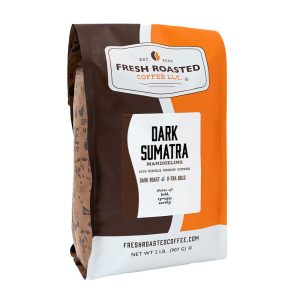
Fresh Roasted Coffee Dark Sumatra Mandheling
Dark chocolate and loamy earth from the first sip, syrupy through the finish, with the roast at maximum and the origin compressed to its most durable character.
Profile
Tasting Notes
- Acidity is absent. The Giling Basah process suppresses it before roasting starts; the dark roast removes what remained.
- Sweetness registers at 2/5: present enough to keep the bittersweet chocolate from going purely bitter, but not present as a distinct quality on its own.
- Dark, roast-forward chocolate at the front. Dry and dense, with a cocoa-powder character at the back of the palate.
- Loamy, cedary earthiness through the mid-cup, the wet-hull character holding through the dark roast in this specific register.
- Body is maximum. Thick, syrupy weight that persists through the entire sip.
Who It’s For
French press and cold brew drinkers who want mass and earth over brightness. This is for the drinker who has learned that sharp grocery-shelf darks disappoint and wants something that holds its weight through a long brew without requiring precision.
Giling Basah is what makes Mandheling interesting, and dark roasting compresses its range. At max roast intensity, the earthy, spiced potential of the origin gets pushed into a single thick note. Drinkers paying specifically for Sumatran origin character will find more of it at a medium-dark roast level, where the process has room to express itself.
Full review
French press is where this coffee delivers the best version of itself. Maximum body means extended contact time works in the cup's favor; the thick, syrupy texture holds across four minutes without breaking down. The chocolate and earth character deepens slightly with immersion, and the absent acidity means there is nothing sharp to amplify. Four minutes is a solid starting point. The cup stays stable.
Cold brew may be the stronger argument overall. Dark roasts often shed their harder edges in cold extraction, and this one follows that pattern. The chocolate softens, the earthiness shifts toward something woodier and tobacco-adjacent at room temperature. The syrupy body holds through dilution because the density is structural, the product of both the wet-hull process and the dark roast working together. For an overnight concentrate, this is a reliable base.
Drip works but leaves less margin. Water around 195°F keeps the already-developed roast from pulling bitterness forward; hotter water amplifies what is already at maximum. Running slightly coarser than your usual dark grind shortens contact time and keeps the loamy earthiness from tipping toward astringency.
Giling Basah is the process that defines Sumatran coffee. Beans are hulled at high moisture content before they finish drying, which restructures the bean's cellular composition. Acidity drops because the biological acids haven't fully developed before disruption; body rises because the denser, partially dried structure retains more dissolved solids under extraction. Dark roasting on top of this is a compressing force. The cedary earthiness and the syrupy body survive because the Giling Basah method has already pushed the coffee's development in that direction. What the roast consumes is range: any brighter quality the Bener Meriah elevation might have contributed is gone before the bag is sealed.
Volcanica's Sumatra Mandheling draws from the same origin and provides useful context. Volcanica tends to roast lighter and sources at the lot level, which leaves more of the origin's character accessible; the earthiness reads as layered, with the cedar and faint spice holding as separate observations rather than merging. Fresh Roasted Coffee's dark version makes a deliberate trade: roast depth for mass, the accessible over the nuanced. Against the Coffee Bean Direct Italian Roast, a dark blend with a comparable performance profile on body and acidity, this Sumatra Mandheling earns its single-origin designation through the earthiness that blends simply do not carry. That earthy character is the cup's Sumatran identity. The roast accounts for everything else.
The 32-ounce format is value positioning, and Fresh Roasted Coffee prices accordingly. This is for daily volume, not the occasional specialty purchase. The origin and the process justify the single-origin label; the pricing does not reach beyond that, and there is no significant brand premium inflating the cost. The value case stands on the cup's most durable quality: the Giling Basah earthiness holds even when the roast has consumed the origin's subtler range.
The bitterness at 3/5 is the number that stands out against the max roast intensity. Dark roasting typically drives bitterness higher; this cup sits at moderate. The Giling Basah method changes how the bean responds to heat. The wet-hull process restructures the cellular composition before roasting begins, and the roast develops on a bean already oriented toward body. The result is a cup that reads syrupy and earthy without tipping into harshness, and that outcome is specific to this combination of process and roast level.
Keep pulling the thread: Dark roast guide, Bener Meriah, Sumatra, Indonesia (single origin) origin guide, and more from Fresh Roasted Coffee.
Price & History
The 32-ounce bag is Fresh Roasted Coffee's value format, placing this at the lower end of per-ounce pricing for dark single-origin Sumatras.
► Show price history (26 days)
| Date | Price | Per oz |
|---|---|---|
| Jul 26, 2026 | $34.99 | $1.093 |
| Jul 25, 2026 | $34.99 | $1.093 |
| Jul 24, 2026 | $34.99 | $1.093 |
| Jul 23, 2026 | $34.99 | $1.093 |
| Jul 22, 2026 | $34.99 | $1.093 |
| Jul 21, 2026 | $34.99 | $1.093 |
| Jul 20, 2026 | $34.99 | $1.093 |
| Jul 19, 2026 | $34.99 | $1.093 |
| Jul 18, 2026 | $34.99 | $1.093 |
| Jul 17, 2026 | $34.99 | $1.093 |
| Jul 15, 2026 | $34.99 | $1.093 |
| Jul 14, 2026 | $34.99 | $1.093 |
| Jul 13, 2026 | $34.99 | $1.093 |
| Jul 12, 2026 | $34.99 | $1.093 |
| Jul 11, 2026 | $34.99 | $1.093 |
| Jul 10, 2026 | $34.99 | $1.093 |
| Jul 9, 2026 | $34.99 | $1.093 |
| Jul 7, 2026 | $34.99 | $1.093 |
| Jul 5, 2026 | $34.99 | $1.093 |
| Jul 4, 2026 | $34.99 | $1.093 |
| Jul 1, 2026 | $34.99 | $1.093 |
| Jun 27, 2026 | $34.99 | $1.093 |
| Jun 25, 2026 | $34.99 | $1.093 |
| Jun 24, 2026 | $34.99 | $1.093 |
| Jun 22, 2026 | $34.99 | $1.093 |
| Jun 21, 2026 | $34.99 | $1.093 |
Rating
FAQ
What does Fresh Roasted Coffee Dark Sumatra Mandheling taste like?
Acidity is absent. The Giling Basah process suppresses it before roasting starts; the dark roast removes what remained. Sweetness registers at 2/5: present enough to keep the bittersweet chocolate from going purely bitter, but not present as a distinct quality on its own. Dark, roast-forward chocolate at the front. Dry and dense, with a cocoa-powder character at the back of the palate.
Who is Fresh Roasted Coffee Dark Sumatra Mandheling best for?
French press and cold brew drinkers who want mass and earth over brightness. This is for the drinker who has learned that sharp grocery-shelf darks disappoint and wants something that holds its weight through a long brew without requiring precision.
Who should skip Fresh Roasted Coffee Dark Sumatra Mandheling?
Giling Basah is what makes Mandheling interesting, and dark roasting compresses its range. At max roast intensity, the earthy, spiced potential of the origin gets pushed into a single thick note. Drinkers paying specifically for Sumatran origin character will find more of it at a medium-dark roast level, where the process has room to express itself.