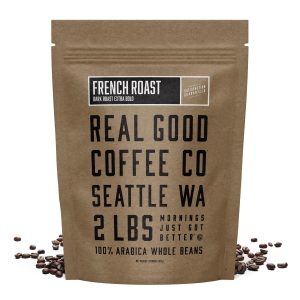
Real Good Coffee Co French Roast
The roast is the entire story here: maximum intensity, heavy body, and a cocoa-powder bitterness that sits forward from the first sip, with origin character almost entirely behind it.
Profile
Tasting Notes
- The raspberry and anise on the label are ghost signals at this roast level. What the cup delivers is a dry, dark-chocolate bitterness that coats the palate rather than building into anything layered.
- Acidity is essentially absent. The 1/5 score is accurate: nothing here brightens or lifts. That is a deliberate design decision for the French Roast category, not a flaw in execution.
- Body is the cup's concrete asset. At 4/5 it sits heavier than most grocery-tier dark roasts, which gives french press and drip preparations a density that lighter roasts in this price tier cannot match.
- Sweetness registers at 2/5: enough to prevent the bitterness from reading as purely punishing, but not enough to soften the carbon edge on the back of the swallow.
Who It’s For
Drip and french press drinkers who have already made their peace with roast character over origin character, and who need a large-format bag that holds its consistency from cup one to cup one hundred. The heavy body reads well under milk.
The finish carries a carbon bite that persists, and anyone pulling espresso at longer extractions will find the bitterness tips unpleasant rather than assertive. More broadly, the 5/5 roast intensity means there is no version of this cup that reveals Central or South American terroir: buyers drawn to this origin for its caramel and fruit depth will not find either.
Full review
San Francisco Bay French Roast is the natural performance benchmark: same price tier, same category, same target drinker. Where SF Bay tends to stop its French Roast just before the carbon threshold, Real Good's version leans deliberately further in. The result is a cup with more roast presence and a more forward bitterness, which is either the feature or the flaw depending on what you are after. For drinkers who find SF Bay's French Roast too restrained at dark-roast volume, this is the logical next step. For drinkers already near the edge of their bitterness tolerance, it crosses the line. Neither is a failure: they occupy adjacent positions in the same category, and the choice between them is a matter of how much roast you want the coffee to taste like.
Against Real Good's own Donut Shop Medium Roast, the flavor profile shift is instructive. The Donut Shop version shows what the arabica base tastes like with less heat applied: creamier, with more sweetness and a gentler finish. The French Roast applies maximum heat to similar sourcing and replaces bean character with roast character. Both are competent at what they do, but they do not do the same thing. Anyone who bought the Donut Shop and expects a similar experience in a darker bag will be surprised by how completely the roast reframes the cup.
The washed process is relevant here, though not in the way French Roast marketing usually implies. Washing typically preserves a coffee's cleaner, more defined fruit and floral signals by removing the mucilage before drying. At 5/5 roast intensity, most of that structural clarity disappears regardless. The origin is a Central and South American blend, which at lighter roasts would likely show caramel and mild fruit depth. Under a French Roast, those signals reduce to a generic dark-chocolate bitterness. What the washed process contributes at this roast level is body integrity: washed arabica from this region gives the cup a structural density that blends relying on lower-grade inputs cannot replicate, even when the flavor distinction has been roasted away.
Body is where the cup earns its keep. At 4/5 it is heavier than most grocery-tier dark roasts, and it holds across french press and drip. A coarser grind in a french press produces a dense cup that takes milk without thinning. Drip is similarly accommodating. Espresso is the more limited context: the roast intensity makes short pulls the only workable approach, and the bitterness reads sharper without the temperature buffer a milk drink provides. Pulled correctly, a ristretto-length shot has the density to anchor a flat white. Pulled long, it tips into something most drinkers will find fatiguing rather than intense.
The 32 oz bag does real work for the value case without current price data available. Large-format bags consistently land at a lower per-ounce cost than smaller packages from the same roaster, and for a high-consumption drip setup or a household with multiple drinkers, that format advantage is concrete. The cup itself does not reach the quality threshold where you would pay a premium for it on flavor alone. A French Roast that performs reliably at scale, holds body in french press, and takes milk without issues is doing most of what the category needs to do. The raspberry and anise the label lists describe the origin's potential at a different roast level: at 5/5 intensity, neither survives to the cup in any identifiable form.
Consistency is where this coffee has its strongest foothold. French Roast is one of the most stable profiles in the roaster's catalogue: the high internal temperature eliminates fermentation variables, terroir signals, and most of the batch-to-batch variance that light and medium roasts carry. What you get in bag one is very close to what you get in bag ten. For a commodity drip setup, that is not a trivial quality. The cost of that consistency is a cup that will never deliver anything unexpected. The roast made sure of that.
Keep pulling the thread: Dark roast guide, Central and South America blend origin guide, and more from Real Good Coffee Co.
Price & History
The 32 oz format makes per-ounce cost the primary purchasing argument, positioning this as a bulk-buy option in a category where smaller bags from specialty roasters charge considerably more for comparable roast intensity.
Price history coming soon — check back after the next daily update.
Rating
FAQ
What does Real Good Coffee Co French Roast taste like?
The raspberry and anise on the label are ghost signals at this roast level. What the cup delivers is a dry, dark-chocolate bitterness that coats the palate rather than building into anything layered. Acidity is essentially absent. The 1/5 score is accurate: nothing here brightens or lifts. That is a deliberate design decision for the French Roast category, not a flaw in execution. Body is the cup's concrete asset. At 4/5 it sits heavier than most grocery-tier dark roasts, which gives french press and drip preparations a density that lighter roasts in this price tier cannot match.
Who is Real Good Coffee Co French Roast best for?
Drip and french press drinkers who have already made their peace with roast character over origin character, and who need a large-format bag that holds its consistency from cup one to cup one hundred. The heavy body reads well under milk.
Who should skip Real Good Coffee Co French Roast?
The finish carries a carbon bite that persists, and anyone pulling espresso at longer extractions will find the bitterness tips unpleasant rather than assertive. More broadly, the 5/5 roast intensity means there is no version of this cup that reveals Central or South American terroir: buyers drawn to this origin for its caramel and fruit depth will not find either.