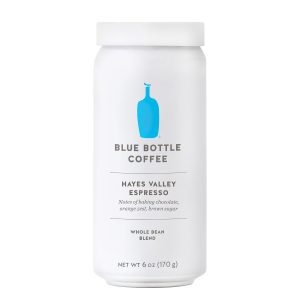
Blue Bottle Hayes Valley Espresso
$1.83 per ounce for a dark espresso blend that earns its place in a milk-drink station but struggles to justify the brand premium for anyone taking shots black.
Affiliate link. We earn a commission at no extra cost to you.
Profile
Tasting Notes
- Acidity sits at 2/5: no citrus edge, no brightness. The cup opens directly onto roast character without a lift of any kind.
- Bittersweet chocolate leads, closer to cocoa powder than milk chocolate. The 4/5 bitterness is forward from first pour to finish.
- Dried fruit surfaces in the mid-palate. A raisin or dark plum character, likely from the Congo component holding partial identity through the dark roast.
- Caramel sweetness (3/5) rounds the base without asserting itself; it reads as structural weight in the cup, not a flavor you will name out loud.
- The finish extends and stays on bitterness. Under steamed milk this integrates; in a straight shot it runs long and keeps running.
Who It’s For
For after-dinner espresso pulled into steamed milk: lattes, cortados, flat whites where the heavy body anchors the drink and the bitterness cuts through dairy without thinning. On moka pot, the dense body and bittersweet character arrive reliably from a setup that demands nothing technical.
The brand premium is hard to defend if you drink espresso black or buy for origin character. The dark roast has absorbed most of what Guatemala, Congo, and Brazil bring individually, and the finish runs long on bitterness with nothing else to hold interest. The price reflects the roaster's name; the cup delivers competent dark espresso, and that is the whole case.
Full review
Hayes Valley arrives at a fundamental roasting decision: apply enough heat to guarantee extraction consistency across every shot, and you trade the origin complexity that justifies a specialty price. At roast intensity 4/5 across a washed Guatemala-Congo-Brazil blend, that trade has already been made. The washed processing keeps the extraction structured and removes ferment haze from the cup, but the processing's contribution to flavor is largely consumed by the heat level. What surfaces is the roast's character, and the three-country sourcing reads more clearly on the bag than in the cup.
In the espresso shot, the sensory numbers play out as predicted. Body lands at 4/5, which is the cup's primary asset: dense, low-acid shots pull thick and hold structure under milk without thinning. Acidity at 2/5 means no lift, no citrus cut, nothing to interrupt the roast-forward character throughout the extraction. The 4/5 bitterness is present from the front of the shot to the finish. Pull short: the bitterness climbs fast when extraction runs long, and there is nothing in the cup to balance it on the way back down.
The Congo component survives partially. Congo coffees carry wine-like ferment character and dried fruit depth at lighter roasts; at this roast intensity those qualities compress into a raisin note in the mid-palate that surfaces in short pulls and disappears when the extraction extends. Caramel sweetness at 3/5 keeps the cup from finishing as purely astringent. You taste it as reduced harshness at the end of the swallow rather than as a distinct caramel note. Bittersweet chocolate and roast-derived bitterness dominate; the dried fruit is secondary and conditional on how you pull the shot.
Counter Culture's Big Trouble operates on similar blend logic: multiple origins selected for espresso consistency over varietal or regional distinction. What separates Hayes Valley is the extra roast depth, which buys predictability across milk drink ratios at the cost of origin transparency. The Congo component would read more clearly in a medium-dark version of the same blend; at this roast level, it functions as a structural contributor to the mid-palate rather than as a flavor identity of its own.
Against the Intelligentsia Black Cat Espresso, the performance difference is real. Black Cat sits in medium-dark territory where the extraction window is wider and the shot reads cleaner across a broader range of temperatures and doses. Hayes Valley's dark profile tightens that range considerably: bitterness climbs fast on a loose grind or long pull, and there is less in the cup rewarding you for the precision it demands. For a blend at this price point, that extraction tolerance is a meaningful consideration if you are not dialing in shots every morning.
For moka pot use, stovetop brewing suits this blend well. High heat and short contact time are inherent to the method: the heavy body holds, the bitterness is expected at this roast level, and the Congo's mid-palate fruit finds more room here than in a machine shot because stovetop brewing is less exacting about what it surfaces from the grounds. The blend was built for concentrated extraction and moka pot is exactly that, with less precision required to get a drinkable result.
This cup costs $1.83 per ounce on a price that has not moved in the monitoring period. Comparable dark espresso blends from specialty roasters outside the major brand tier price lower, and the cup quality gap is real but narrow. For a milk-drink espresso station where the Blue Bottle name carries weight and blend consistency matters more than origin expression, the spend is defensible. For straight espresso, for anyone comparing on flavor versus price, the cup delivers competent dark espresso and the rest of the price tag is the Blue Bottle name.
Keep pulling the thread: Dark roast guide, Guatemala, Congo, Brazil blend origin guide, and more from Blue Bottle Coffee.
Price & History
The price has held flat at $22.00 for the full monitoring period, with only two data points recorded and no discounts observed. At $1.83 per ounce, there is no low to wait for and no seasonal pattern visible in the available data. If Hayes Valley fits the setup, buy when needed. The pricing shows no movement; this appears to be a fixed shelf price, not one that dips.
► Show price history (38 days)
| Date | Price | Per oz |
|---|---|---|
| Jul 26, 2026 | $22.00 | $1.833 |
| Jul 25, 2026 | $22.00 | $1.833 |
| Jul 24, 2026 | $22.00 | $1.833 |
| Jul 23, 2026 | $22.00 | $1.833 |
| Jul 22, 2026 | $22.00 | $1.833 |
| Jul 21, 2026 | $22.00 | $1.833 |
| Jul 20, 2026 | $22.00 | $1.833 |
| Jul 19, 2026 | $22.00 | $1.833 |
| Jul 18, 2026 | $22.00 | $1.833 |
| Jul 17, 2026 | $22.00 | $1.833 |
| Jul 16, 2026 | $22.00 | $1.833 |
| Jul 15, 2026 | $22.00 | $1.833 |
| Jul 14, 2026 | $22.00 | $1.833 |
| Jul 13, 2026 | $22.00 | $1.833 |
| Jul 12, 2026 | $22.00 | $1.833 |
| Jul 11, 2026 | $22.00 | $1.833 |
| Jul 10, 2026 | $22.00 | $1.833 |
| Jul 9, 2026 | $22.00 | $1.833 |
| Jul 8, 2026 | $22.00 | $1.833 |
| Jul 7, 2026 | $22.00 | $1.833 |
| Jul 6, 2026 | $22.00 | $1.833 |
| Jul 5, 2026 | $22.00 | $1.833 |
| Jul 4, 2026 | $22.00 | $1.833 |
| Jul 3, 2026 | $22.00 | $1.833 |
| Jul 2, 2026 | $22.00 | $1.833 |
| Jul 1, 2026 | $22.00 | $1.833 |
| Jun 30, 2026 | $22.00 | $1.833 |
| Jun 29, 2026 | $22.00 | $1.833 |
| Jun 28, 2026 | $22.00 | $1.833 |
| Jun 27, 2026 | $22.00 | $1.833 |
| Jun 26, 2026 | $22.00 | $1.833 |
| Jun 25, 2026 | $22.00 | $1.833 |
| Jun 24, 2026 | $22.00 | $1.833 |
| Jun 23, 2026 | $22.00 | $1.833 |
| Jun 22, 2026 | $22.00 | $1.833 |
| Jun 21, 2026 | $22.00 | $1.833 |
| Jun 14, 2026 | $22.00 | $1.833 |
| Jun 13, 2026 | $22.00 | $1.833 |
Rating
FAQ
What does Blue Bottle Hayes Valley Espresso taste like?
Acidity sits at 2/5: no citrus edge, no brightness. The cup opens directly onto roast character without a lift of any kind. Bittersweet chocolate leads, closer to cocoa powder than milk chocolate. The 4/5 bitterness is forward from first pour to finish. Dried fruit surfaces in the mid-palate. A raisin or dark plum character, likely from the Congo component holding partial identity through the dark roast.
Who is Blue Bottle Hayes Valley Espresso best for?
For after-dinner espresso pulled into steamed milk: lattes, cortados, flat whites where the heavy body anchors the drink and the bitterness cuts through dairy without thinning. On moka pot, the dense body and bittersweet character arrive reliably from a setup that demands nothing technical.
Who should skip Blue Bottle Hayes Valley Espresso?
The brand premium is hard to defend if you drink espresso black or buy for origin character. The dark roast has absorbed most of what Guatemala, Congo, and Brazil bring individually, and the finish runs long on bitterness with nothing else to hold interest. The price reflects the roaster's name; the cup delivers competent dark espresso, and that is the whole case.