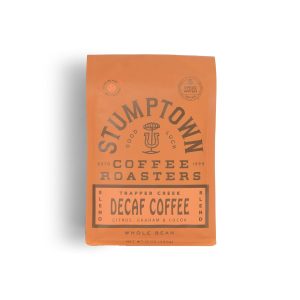
Stumptown Trapper Creek Decaf
Handles espresso, drip, and french press without the bitterness that typically betrays a dark decaf at high roast intensity.
Profile
Tasting Notes
- The cocoa character opens roast-dark; as the cup cools, it settles into cocoa powder dryness: less intensity, more definition.
- Graham-cracker sweetness anchors the mid-palate without adding sugar weight. It holds the cup from reading hollow.
- At shorter extractions, dried cherry sits briefly behind the cocoa before the roast pulls focus. Longer pulls erase it.
- Body is 4/5. French press amplifies it; espresso concentrates it into the shot.
- Bitterness holds at 2/5 through 4/5 roast intensity. That is what keeps the cup usable without adjustment.
Who It’s For
Decaf drinkers who want a dark roast that performs like one: heavy body and low bitterness in a cocoa-forward profile that holds up in espresso without milk. If you need to hand this to someone who avoids decaf on taste grounds, the cup gives you a real argument.
Stumptown commands a specialty-roaster price on a Latin America blend roasted dark, and at that roast intensity origin character is largely gone. If you are paying for terroir, this does not deliver it. A cheaper Swiss Water dark decaf closes the functional gap faster than the brand premium justifies.
Full review
The Latin America blend origin at dark roast follows a well-worn arc: acidity burns off early, body builds, and cocoa dominates. Swiss Water decaffeination works along the same logic. Caffeine is removed via osmosis and activated charcoal filters, a process that uses no chemical solvents, so the volatile compounds that contribute to flavor survive better than they do with cheaper alternatives. The outcome is a cup where the dark roast's character comes through intact. No solvent flatness, no chemical aftertaste.
Where it separates from generic dark decafs is in the bitterness number. At 4/5 roast intensity, holding bitterness to 2/5 shapes how this coffee behaves across methods in a way most dark roasts at this intensity do not manage. Drip extractions land drinkable without precise dial-in. French press, which tends to amplify roast sharpness as brew time extends, stays manageable: body comes through full and the finish stays dry. Espresso is the clearest case. The shot pulls dense, crema holds, and the cocoa-powder character translates directly. Extraction bitterness does not distort it.
The cocoa and body behave differently across methods, but both remain present. In espresso, the body densifies; cocoa reads darker and more concentrated on the front, then fades toward cocoa powder as the shot cools. Drip produces a more moderate cup: the body thins slightly and the dried fruit note from the producer's spec has room to emerge in the background. French press runs longer on extraction and produces a deeper, warmer cup. None of the three tips thin. For a roast running at 4/5 intensity, that clean exit across every method is unusual.
Against the Kicking Horse Decaf Swiss Water Dark Roast, the performance comparison runs close. Both deliver heavy body and low acidity in a dark roast profile. Stumptown operates at lower bitterness through comparable roast intensity. In espresso, that gap is the difference between a shot you can drink black and one that wants milk to balance it. In drip and french press, the margin narrows considerably.
The Stumptown French Roast Organic covers similar flavor-profile ground: dark, cocoa-forward, body-driven. Trapper Creek pulls back the acidity further, as both the decaf processing and the blend construction push in that direction, but the flavor logic runs parallel. The distinction is context. Trapper Creek is the version for when caffeine is the constraint.
The sweetness at 3/5 is doing structural work in a cup at this roast intensity. A high-roast dark with no sweetness reserve dries on the swallow and reads harsh. The buffer here keeps the finish from going hard. The dried fruit note from the producer's spec is the likely mechanism: it reads as structural support in the cup, softening the exit. That inference holds against how the cup behaves across all three brew methods. No method produces a sharp close.
Stumptown's price positions this above grocery-tier and in line with other name-roaster decafs. The cup earns the method and the execution. The blend origin is where the story stops: Latin America at 4/5 roast intensity means terroir has been traded for roast character, and the drinker is buying quality control and process integrity. Whether the premium over a cheaper Swiss Water dark decaf is justified depends on how much that overhead is worth. The gap between this and a competent cheaper alternative is real, but not wide.
Keep pulling the thread: Dark roast guide, Latin America blend origin guide, and more from Stumptown.
Price & History
At 12 oz, Trapper Creek sits at Stumptown's standard specialty-decaf price point, above mass-market Swiss Water options and in line with other name-roaster dark decafs. [Buy Stumptown Trapper Creek Decaf on Amazon](https://www.amazon.com/dp/B00RXYPJZM?tag=coffeebeanind-20)
► Show price history (26 days)
| Date | Price | Per oz |
|---|---|---|
| Jul 26, 2026 | $20.00 | $1.667 |
| Jul 25, 2026 | $20.00 | $1.667 |
| Jul 24, 2026 | $20.00 | $1.667 |
| Jul 23, 2026 | $20.00 | $1.667 |
| Jul 22, 2026 | $20.00 | $1.667 |
| Jul 21, 2026 | $20.00 | $1.667 |
| Jul 20, 2026 | $20.00 | $1.667 |
| Jul 19, 2026 | $20.00 | $1.667 |
| Jul 18, 2026 | $20.00 | $1.667 |
| Jul 17, 2026 | $20.00 | $1.667 |
| Jul 15, 2026 | $20.00 | $1.667 |
| Jul 14, 2026 | $20.00 | $1.667 |
| Jul 13, 2026 | $20.00 | $1.667 |
| Jul 12, 2026 | $20.00 | $1.667 |
| Jul 11, 2026 | $20.00 | $1.667 |
| Jul 10, 2026 | $20.00 | $1.667 |
| Jul 9, 2026 | $20.00 | $1.667 |
| Jul 7, 2026 | $20.00 | $1.667 |
| Jul 5, 2026 | $20.00 | $1.667 |
| Jul 4, 2026 | $20.00 | $1.667 |
| Jul 1, 2026 | $20.00 | $1.667 |
| Jun 27, 2026 | $20.00 | $1.667 |
| Jun 25, 2026 | $20.00 | $1.667 |
| Jun 24, 2026 | $20.00 | $1.667 |
| Jun 22, 2026 | $20.00 | $1.667 |
| Jun 21, 2026 | $20.00 | $1.667 |
Rating
FAQ
What does Stumptown Trapper Creek Decaf taste like?
The cocoa character opens roast-dark; as the cup cools, it settles into cocoa powder dryness: less intensity, more definition. Graham-cracker sweetness anchors the mid-palate without adding sugar weight. It holds the cup from reading hollow. At shorter extractions, dried cherry sits briefly behind the cocoa before the roast pulls focus. Longer pulls erase it.
Who is Stumptown Trapper Creek Decaf best for?
Decaf drinkers who want a dark roast that performs like one: heavy body and low bitterness in a cocoa-forward profile that holds up in espresso without milk. If you need to hand this to someone who avoids decaf on taste grounds, the cup gives you a real argument.
Who should skip Stumptown Trapper Creek Decaf?
Stumptown commands a specialty-roaster price on a Latin America blend roasted dark, and at that roast intensity origin character is largely gone. If you are paying for terroir, this does not deliver it. A cheaper Swiss Water dark decaf closes the functional gap faster than the brand premium justifies.