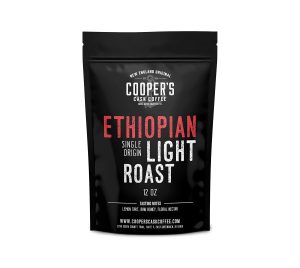
Cooper’s Cask Ethiopia Bold Light Roast
At a premium Grade 1 price, "Bold" is a label the roasting never earned: the Goma Woreda lot itself delivers the lemon-tart brightness and wild berry sweetness, and the natural process does the rest.
Profile
Tasting Notes
- Lemon-tart brightness leads, high enough to cut through the sweetness but not sharp enough to pucker.
- Wild berry follows: natural process skin contact pulls dried cherry and strawberry, concentrated and slightly jammy where a washed Ethiopian stays citric.
- Raw honey fills the mid-palate. It arrives from the fermentation, a slow thick sweetness the bean's own sugars alone would not produce.
- Floral nectar is a volatile top note. You get it in the first half of the pour over; it fades as the cup cools and recedes before the final third.
- The medium body (3/5) puts substance behind the brightness. This cup has structure; it does not thin out.
Who It’s For
Pour over and drip drinkers who want fruit-forward sweetness with enough body to stand up at a normal extraction ratio. If previous Grade 1 Ethiopian lots have tasted thin or watery, the natural process here is the fix: the fermentation adds body and sweetness that washed lots in this tier strip away.
The "Bold" label will pull in drinkers expecting intensity, and this cup will not deliver it: 1/5 roast intensity, near-zero bitterness, and high fruit sweetness point in the opposite direction entirely. The espresso listing is also optimistic. Low roast development and high acidity are a difficult combination under pressure; the shot acidity amplifies, the sweetness can tip cloying, and the low development creates channeling risk on anything other than a well-dialed grinder.
Full review
The Coffee Bean & Tea Leaf Ethiopia Yirgacheffe is the performance reference most buyers carry for Ethiopian light roasts: floral, citric, lean, and precise. Cooper's Cask's Goma Woreda lot starts from the same origin category and builds a different cup. The natural process adds body and fermentation-derived sweetness the benchmark Yirgacheffe profile does not carry. Wild berry appears where Yirgacheffe gives jasmine. Raw honey fills the mid-palate where Yirgacheffe stays spare and citric and moves on. Both are Ethiopian light roasts. The flavor architecture is far enough apart that comparing them on taste alone misses the point: they serve different drinker priorities.
Fresh Roasted Coffee's Organic Ethiopian Sidamo Guji sits in adjacent origin territory: Grade 1 Ethiopian, comparable altitude band, and the same high-grown terroir conditions that produce bright acidity and expressive fruit. The origin logic between these two cups is tight. The distinction is process. Where the Guji lot runs washed and resolves to citric clarity, this Goma Woreda runs natural, which trades that clarity for fermented berry depth and honey sweetness. Neither is better in the abstract. They are different tools for different flavor preferences.
The roasting decision is where the marketing and the cup diverge most visibly. "Bold" implies intensity the heat applied never created: roast intensity sits at 1/5, the lowest register on the scale, and bitterness is essentially absent. What Cooper's Cask has done is delegate the flavor work to the natural process and the Grade 1 lot, then pulled back from the drum. The lemon-tart acidity (4/5) and sweetness (4/5) both read as origin and process expression. There is no roast character here to speak of. The cup's identity is terroir and fermentation, period.
That is a legitimate craft position. A roaster who deliberately minimizes development to preserve origin transparency makes a defensible call, and the result is what buyers paying a premium for single-origin Ethiopian are supposed to get. The Goma Woreda woreda sits at elevation, and the Grade 1 classification in the Ethiopian grading system reflects careful cherry selection: only defect-free lots qualify. The flavors in the cup (lemon tart, raw honey, floral nectar, wild berry) are the product of those conditions and the natural fermentation, not of anything that happened in the roasting drum.
The medium body (3/5) is the most practically important spec for buyers comparing this to other Grade 1 Ethiopian light roasts. Many such lots trade body for clarity and land thin in the cup, requiring tight extraction control to avoid reading as watery or weak. This one holds. Pour overs at a standard 1:15 ratio have something behind the brightness. That substance makes the recipe window more accessible than the roast level implies, and it is the concrete quality that separates this cup from technically interesting but practically demanding lots in the same tier.
The espresso claim warrants a direct correction. The low roast development and high acidity are a difficult pull: the acidity amplifies under pressure, the fermentation sweetness can tip cloying, and the low development makes channeling easy on any grinder without tight distribution. Pour over and drip extract this predictably and without the dialing overhead. Espresso is possible, but "best brew method" overstates the case for most setups.
Buyers who reach for this expecting the punch the "Bold" label implies will be confused by the first pour. The cup is expressive, sweet, and fruit-forward. Those are real selling points. "Bold" is not the right word for any of them, and the branding creates an expectation gap the cup cannot close.
Keep pulling the thread: Light roast guide, Goma Woreda, Ethiopia (single origin, Grade 1) origin guide, and more from Cooper’s Cask Coffee.
Price & History
At 12 oz, this positions in the premium specialty tier for Grade 1 Ethiopian natural process lots, where verified single-origin sourcing and defect-free grading consistently command above-commodity pricing.
► Show price history (26 days)
| Date | Price | Per oz |
|---|---|---|
| Jul 26, 2026 | $18.95 | $1.579 |
| Jul 25, 2026 | $18.95 | $1.579 |
| Jul 24, 2026 | $18.95 | $1.579 |
| Jul 23, 2026 | $18.95 | $1.579 |
| Jul 22, 2026 | $18.95 | $1.579 |
| Jul 21, 2026 | $18.95 | $1.579 |
| Jul 20, 2026 | $18.95 | $1.579 |
| Jul 19, 2026 | $18.95 | $1.579 |
| Jul 18, 2026 | $18.95 | $1.579 |
| Jul 17, 2026 | $18.95 | $1.579 |
| Jul 15, 2026 | $18.95 | $1.579 |
| Jul 14, 2026 | $18.95 | $1.579 |
| Jul 13, 2026 | $18.95 | $1.579 |
| Jul 12, 2026 | $18.95 | $1.579 |
| Jul 11, 2026 | $18.95 | $1.579 |
| Jul 10, 2026 | $18.95 | $1.579 |
| Jul 9, 2026 | $18.95 | $1.579 |
| Jul 7, 2026 | $18.95 | $1.579 |
| Jul 5, 2026 | $18.95 | $1.579 |
| Jul 4, 2026 | $18.95 | $1.579 |
| Jul 1, 2026 | $18.95 | $1.579 |
| Jun 27, 2026 | $18.95 | $1.579 |
| Jun 25, 2026 | $18.95 | $1.579 |
| Jun 24, 2026 | $18.95 | $1.579 |
| Jun 22, 2026 | $18.95 | $1.579 |
| Jun 21, 2026 | $18.95 | $1.579 |
Rating
FAQ
What does Cooper’s Cask Ethiopia Bold Light Roast taste like?
Lemon-tart brightness leads, high enough to cut through the sweetness but not sharp enough to pucker. Wild berry follows: natural process skin contact pulls dried cherry and strawberry, concentrated and slightly jammy where a washed Ethiopian stays citric. Raw honey fills the mid-palate. It arrives from the fermentation, a slow thick sweetness the bean's own sugars alone would not produce.
Who is Cooper’s Cask Ethiopia Bold Light Roast best for?
Pour over and drip drinkers who want fruit-forward sweetness with enough body to stand up at a normal extraction ratio. If previous Grade 1 Ethiopian lots have tasted thin or watery, the natural process here is the fix: the fermentation adds body and sweetness that washed lots in this tier strip away.
Who should skip Cooper’s Cask Ethiopia Bold Light Roast?
The "Bold" label will pull in drinkers expecting intensity, and this cup will not deliver it: 1/5 roast intensity, near-zero bitterness, and high fruit sweetness point in the opposite direction entirely. The espresso listing is also optimistic. Low roast development and high acidity are a difficult combination under pressure; the shot acidity amplifies, the sweetness can tip cloying, and the low development creates channeling risk on anything other than a well-dialed grinder.