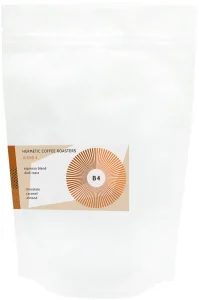
Hermetic Coffee Roasters B 2 – Espresso Blend
Full-bodied from the first pull to a sweet, slow finish: three origins stacked into a cup that earns its espresso weight on density and sweetness alone.
Profile
Tasting Notes
- Thick, syrupy weight from first contact; the cup settles heavy in the mouth and stays there through the finish.
- Sweetness is malt-driven and persistent: caramel depth from the Brazil natural lots, not the brightness of fruit sugars.
- Dark chocolate on the swallow, hazelnut dry and understated immediately after.
- Grapefruit brightness arrives mid-palate from the Huehuetenango component, providing structural contrast without tipping the cup acidic.
- Blackberry concentrates on tighter pulls and fades behind the chocolate base under longer extraction ratios.
Who It’s For
Espresso and moka pot mornings that need weight without aggression. The body is substantial enough to anchor a milk drink without collapsing, and the moderate bitterness means you won't spend every morning chasing extraction precision.
The grapefruit brightness from the Guatemala component depends on getting the extraction dialed. An under-extracted pull collapses that mid-palate lift and leaves a flat chocolate base; the failure mode is subtle enough that you won't immediately know what's missing. That calibration demand is real friction for anyone who brews on autopilot.
Full review
Hermetic's B 3 is the flavor-distinction benchmark within the lineup, and the B 2 arrives with a different priority. Where the B 3 pursues identifiable origin clarity, the B 2 layers three sourcing traditions from three separate production contexts and asks them to coexist. The cup reads as constructed rather than discovered. Intelligentsia's Black Cat Classic is the more instructive performance reference: it is an industry calibration point for espresso consistency and dose tolerance, built to reward a competent barista on any machine. The B 2 approaches a comparable role through a different mechanism. Maximum body and sweetness give it a wide, forgiving extraction window; the three-origin complexity asks slightly more of the grinder than Black Cat's tighter construction does at the same dose.
The flavor structure runs from dark to bright. The Sumatra and Brazil contributions dominate the front of the cup with chocolate, hazelnut, and a syrupy physical weight that is the product of both the natural processing and the Indonesian semi-washed lot. Then Guatemala Huehuetenango interrupts that weight with grapefruit brightness in the mid-palate. It sits as structural contrast to the Brazil-Sumatra heaviness, not as a decoration layered on top. Blackberry is present on the swallow, though it compresses under longer extraction ratios. The finish is caramel-malt sweet, and the bitterness sits low enough that it never sharpens the tail of the cup.
What produces this profile is the collision of three very different agricultural traditions. Brazil Cerrado is a large-volume, naturally processed origin with low acidity, high sweetness, and a chocolate-nut character. Natural processing leaves fruit sugars intact through the drying phase, and Cerrado's flat, consistent terrain encourages even ripening across the harvest. Sumatra, processed semi-washed, functions as the body engine: low acidity, earthy depth, and a full cup weight that medium-dark roasters typically have to coax out of the drum. Guatemala Huehuetenango is the counterweight. It is a high-altitude washed origin with defined acidity and fruit clarity, and it is doing the work of keeping the B 2 from reading as one-dimensional. Balancing all three at a single medium roast, without letting any element flatten the others, is a harder roasting problem than the label suggests.
The grapefruit note is the one variable worth tracking. Most pulls land it cleanly as a brightness that lifts the mid-palate. Under-extracted shots lose it entirely, leaving a cup that tastes finished but is structurally incomplete. You won't get a harsh or sour pull; you'll get a flat one. That is the subtler and harder problem to diagnose, because the cup won't announce itself as wrong.
A 12 oz bag at specialty pricing buys primarily the three-origin construction and the precision required to balance it at medium roast. A commodity espresso blend at the same weight costs less and offers a simpler, more predictable cup. Whether that trade is worth making depends on what the drinker is replacing. The B 2 delivers cup complexity that a single-origin blend at this roast level rarely achieves, at the cost of a less repeatable dialing process between batches. Three-origin blends can shift slightly between harvests when any one sourcing component varies; the flavor foundation holds, but the grapefruit intensity may move more than a two-component blend would.
The anise and cinnamon the producer lists are background presences. Present in a deliberate tasting, not what leads the cup. The tobacco and malt land on the aftertaste and linger. In a straight espresso shot, that persistence is what separates this from a medium roast designed for filter.
Keep pulling the thread: Medium roast guide, Brazil, Cerrado, Guatemala, Indonesia, Huehuetenango, Sumatra origin guide, and more from Hermetic Coffee Roasters.
Price & History
At 12 oz, this sits in the specialty-tier price range for a multi-origin house espresso blend, consistent with how Hermetic prices across its lineup.
Price history coming soon — check back after the next daily update.
Rating
FAQ
What does Hermetic Coffee Roasters B 2 – Espresso Blend taste like?
Thick, syrupy weight from first contact; the cup settles heavy in the mouth and stays there through the finish. Sweetness is malt-driven and persistent: caramel depth from the Brazil natural lots, not the brightness of fruit sugars. Dark chocolate on the swallow, hazelnut dry and understated immediately after.
Who is Hermetic Coffee Roasters B 2 – Espresso Blend best for?
Espresso and moka pot mornings that need weight without aggression. The body is substantial enough to anchor a milk drink without collapsing, and the moderate bitterness means you won't spend every morning chasing extraction precision.
Who should skip Hermetic Coffee Roasters B 2 – Espresso Blend?
The grapefruit brightness from the Guatemala component depends on getting the extraction dialed. An under-extracted pull collapses that mid-palate lift and leaves a flat chocolate base; the failure mode is subtle enough that you won't immediately know what's missing. That calibration demand is real friction for anyone who brews on autopilot.