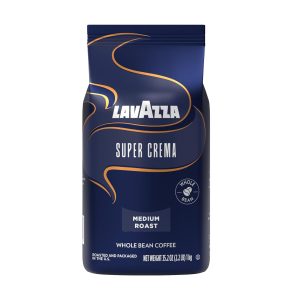
Lavazza Super Crema
The blend flattens three origins into a single, predictable profile, but the body is real and the low acidity makes it forgiving on home espresso equipment.
Affiliate link. We earn a commission at no extra cost to you.
Profile
Tasting Notes
- Acidity is near-absent. The cup opens flat rather than bright. Nothing lifts the front end before the body takes over.
- Hazelnut and brown sugar sit in the mid-palate, not the finish. Both are recognisable but neither is defined or assertive.
- The cocoa reads as dry Maillard-driven roast character, not sweetness. Cocoa-powder dryness on the swallow, not chocolate.
- Body is the headline: dense enough to hold crema under home-machine pressure and to carry milk without thinning.
- The finish settles fast. A brief roast warmth is what remains, no trailing dryness.
Who It’s For
Espresso and moka pot drinkers on home consumer machines who want a cup that holds together when the grind or timing drifts. The body also makes this a functional base for flat whites and cappuccinos where the coffee has to survive dilution.
Three origins blended into one predictable profile means origin character is gone entirely, and the price demands more than a commodity cup can deliver. At the $60-plus range this bag reached earlier in the month, there are more interesting and traceable coffees for the same money.
Full review
Brazil, Colombia, and Indonesia arrive in the same bag and leave as one thing. That is not an accident. Super Crema was not built to express origins. It was built to produce the same shot on a $400 machine on Tuesday as it did on Monday, without asking the drinker to recalibrate between brews. Understanding that design intention is the most useful frame for evaluating it.
The Colombia provides the blend's faint sweetness and its overall approachability. Brazil anchors the nut-roast and hazelnut register that is the cup's loudest flavour. Indonesia is structural: it adds body, extends texture into milk, and keeps the shot from thinning on longer pulls. The washed and natural components do not layer into distinct process character the way a thoughtful blender might achieve. They merge into a single texture. The result is a cup that tastes like a well-executed Italian commercial blend, which is exactly what it is.
In espresso, the low acidity (2/5) is the functional advantage. Brightness does not spike on short shots or drop out on longer ones, which gives the drinker more room to work across extraction lengths. A home grinder with some shot-to-shot variation does not destabilise every pull. Café Don Pablo's Signature Blend operates in the same flavour territory: comparable hazelnut register, similar low-acid body, broadly accessible profile. Super Crema's body is denser, which shows up in the crema and in how the shot holds its structure when steamed milk is added.
The moka pot result is where this profile earns its keep most clearly. A 4/5 body in stovetop brewing produces a cup that does not go watery. The brown sugar and mild cocoa are slightly more legible here than in espresso, where roast character competes more directly. The finish is brief. As the cup cools, it does not turn astringent, which is a real concern with blends that lean on Indonesian origins.
Illy Classico is the relevant performance comparison. Illy blends across nine origins with industrial-grade quality control, and the shot-to-shot consistency is notably tighter. The cup is also more refined: the flavour distinction between batches is smaller, the crema more uniform. Super Crema is less precise and slightly more variable across bags, but it is cheaper per ounce in most conditions. For the home drinker who cannot detect the difference between a 93-point and a 95-point extraction, that price gap is the real deciding factor.
The value case splits cleanly by price point. At $53.45, the current 30-day floor, 35.2 oz of a forgiving, consistent espresso blend at $1.52 per ounce is defensible for the use case it serves. A home espresso drinker on consumer equipment gets more reliable results per dollar here than from a specialty single-origin at double the price, where extraction precision becomes the actual variable. For the specialty buyer who wants origin traceability and process clarity, this is the wrong category at any price.
The limitation does not soften with context: this is a blend built for compliance, not distinction. The profile never opens up or changes across the bag. What you taste on day one is what you taste on day thirty.
Keep pulling the thread: Medium roast guide, Brazil, Colombia, Indonesia blend origin guide, and more from Lavazza.
Price & History
The current price of $53.45 is the 30-day floor, 14.5% below the month's average of $62.50 and well clear of the $65.01 high the bag touched earlier in the period. For 35.2 oz, that gap is worth acting on. If this blend fits your setup, now is the right moment. When it returns to the $60-plus range, the value case against comparable commodity blends becomes considerably harder to make.
Price history coming soon — check back after the next daily update.
Rating
FAQ
What does Lavazza Super Crema taste like?
Acidity is near-absent. The cup opens flat rather than bright. Nothing lifts the front end before the body takes over. Hazelnut and brown sugar sit in the mid-palate, not the finish. Both are recognisable but neither is defined or assertive. The cocoa reads as dry Maillard-driven roast character, not sweetness. Cocoa-powder dryness on the swallow, not chocolate.
Who is Lavazza Super Crema best for?
Espresso and moka pot drinkers on home consumer machines who want a cup that holds together when the grind or timing drifts. The body also makes this a functional base for flat whites and cappuccinos where the coffee has to survive dilution.
Who should skip Lavazza Super Crema?
Three origins blended into one predictable profile means origin character is gone entirely, and the price demands more than a commodity cup can deliver. At the $60-plus range this bag reached earlier in the month, there are more interesting and traceable coffees for the same money.