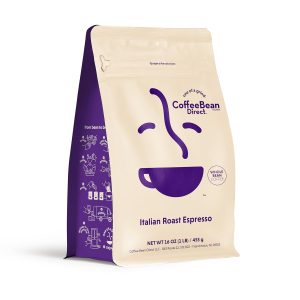
Coffee Bean Direct Italian Roast Espresso
The decision to roast this at maximum intensity sacrifices a four-origin blend's potential for a single, predictable register: heavy body and cocoa-powder bitterness that holds under milk but flattens black.
Profile
Tasting Notes
- Cocoa powder leads: dry and dusty, the kind of dark-chocolate note that registers as unsweetened baking cocoa, which is what 2/5 sweetness at maximum roast intensity produces.
- Smoky molasses at the back of the swallow, more char than sugar. The sweetness doesn't develop far enough to counterbalance the bitterness at the front.
- Body is the standout: heavy and coating at 4/5, it fills out a shot without going watery and gives french press real structural weight.
- The finish is short. Push extraction past a standard pull and the bitterness sharpens toward ash.
- A faint nuttiness in the mid-palate, quiet and easily overridden as temperature climbs.
Who It’s For
Milk-based espresso is where this belongs. The heavy body integrates with steamed milk in ways a thinner roast cannot, and the bitterness at 4/5 provides backbone without the cup going flabby. Black, it runs one-dimensional.
The label names four origins (Brazil, Costa Rica, Sumatra, Kenya), which implies a cup with real range. At roast intensity 5/5, that range is consumed. The Kenya component would deliver brightness and fruit under a lighter hand; here it contributes a faint savory edge at best. The multi-origin label is a promise the roast level cannot keep, and you'll pay a small premium for complexity the cup does not deliver.
Full review
A roast at 5/5 intensity is a deliberate trade, and the cup reflects it directly. Kenya's SL-28 varietals carry bright citrus at lighter roast levels; Costa Rica's high-grown lots carry stone fruit and clean sweetness. Sumatra at medium-light would bring earthy, low-acid depth with that characteristic syrupy body. Push heat this far and those contributions collapse into a single register: deep, charred, consistent. This is what Italian-style roasting does by design. The four origins contribute a subtle texture to the bitterness, which is the honest case for a multi-origin blend at this roast level, but nothing in the cup reads as distinct origin character.
The sensory shape is straightforward. Bitterness at 4/5 dominates from the first sip. The cocoa-powder quality is real, dry and dusty on the tongue, and it persists through most of the cup. Underneath sits a smoky molasses register: deep charcoal heat converted into something that evokes dark sugar without being sweet. Sweetness at 2/5 tells the accurate story. Acidity at 1/5 means there is no brightness to cut through the bitterness, no high note that lifts the cup or extends the finish. The natural-processed component of the blend would carry fruit sweetness under a gentler roast; at maximum intensity, that sweetness converts into the smoky backbone. The flavor is in the first third of the cup. After that, bitterness is what remains.
Body at 4/5 is where this delivers its clearest argument. In the espresso shot, the weight is real: the crema has substance, the mouthfeel is coating, and the cup fills out in a way that thinner commodity roasts at this price point fail to do. In a flat white or cortado, the body holds through steamed milk and gives the drink a backbone that matters. On flavor profile, Cafe Bustelo Espresso Style Dark Roast occupies similar territory: comparably bitter, cocoa-forward, dark. The functional distinction is that Coffee Bean Direct's heavier body holds its shape in milk-based drinks where Cafe Bustelo runs thin.
Against Eight O'Clock Dark Italian Espresso on a performance basis, the gap is real but not large. Eight O'Clock pulls consistently and is accessible for a machine-friendly espresso, and it's one of the more forgiving dark-roast blends at its price point. Coffee Bean Direct has a concrete edge in mouthfeel density and crema thickness, which shows in a side-by-side pull. The performance difference lands in the range of noticeably better without being categorical. For a semi-automatic machine at standard pressure without profiling, both pull reliably. The Coffee Bean Direct body advantage shows most clearly in a milk-based drink, where the added weight gives the finished cup more structure.
The 16-ounce pack is sized for volume use. The one thing this blend offers that a cheaper single-origin dark roast cannot replicate is the multi-origin base: four origins, even compressed into a single register, produce a more textured bitterness than a flat single-origin. That layering is subtle and most detectable in french press, where the longer extraction has time to find it. At commodity pricing for a named multi-origin espresso blend, the body weight and roast consistency make a defensible case. In a black-coffee context, the four-origin investment returns a single-register cup, and the value argument weakens accordingly.
French press pulls more from this than drip does. The immersion format extracts the smoky-molasses register over a longer steep, and the heavier body fills the plunger well. Coarse grind matters here; too fine and the immersion extracts harsh. Drip amplifies the bitterness without milk to anchor it, and the one-note profile becomes more apparent in a full-size brewed cup. An americano or iced preparation reduces the cup to its bitterest components; the body and the smoky register both fade when diluted. The french press format is the one place in the lineup where the smoky-molasses note has room to develop.
Keep pulling the thread: Dark roast guide, Brazil, Costa Rica, Sumatra, Kenya blend origin guide, and more from Coffee Bean Direct.
Price & History
The 16-ounce pack is Coffee Bean Direct's standard offering for this blend, sized for volume espresso use where per-ounce cost matters more than occasion-specific brewing.
► Show price history (26 days)
| Date | Price | Per oz |
|---|---|---|
| Jul 26, 2026 | $19.95 | $1.247 |
| Jul 25, 2026 | $19.95 | $1.247 |
| Jul 24, 2026 | $19.95 | $1.247 |
| Jul 23, 2026 | $19.95 | $1.247 |
| Jul 22, 2026 | $19.95 | $1.247 |
| Jul 21, 2026 | $19.95 | $1.247 |
| Jul 20, 2026 | $19.95 | $1.247 |
| Jul 19, 2026 | $19.95 | $1.247 |
| Jul 18, 2026 | $19.95 | $1.247 |
| Jul 17, 2026 | $19.95 | $1.247 |
| Jul 15, 2026 | $19.95 | $1.247 |
| Jul 14, 2026 | $19.95 | $1.247 |
| Jul 13, 2026 | $19.95 | $1.247 |
| Jul 12, 2026 | $19.95 | $1.247 |
| Jul 11, 2026 | $19.95 | $1.247 |
| Jul 10, 2026 | $19.95 | $1.247 |
| Jul 9, 2026 | $19.95 | $1.247 |
| Jul 7, 2026 | $19.95 | $1.247 |
| Jul 5, 2026 | $19.95 | $1.247 |
| Jul 4, 2026 | $19.95 | $1.247 |
| Jul 1, 2026 | $19.95 | $1.247 |
| Jun 27, 2026 | $19.95 | $1.247 |
| Jun 25, 2026 | $19.95 | $1.247 |
| Jun 24, 2026 | $19.95 | $1.247 |
| Jun 22, 2026 | $19.95 | $1.247 |
| Jun 21, 2026 | $19.95 | $1.247 |
Rating
FAQ
What does Coffee Bean Direct Italian Roast Espresso taste like?
Cocoa powder leads: dry and dusty, the kind of dark-chocolate note that registers as unsweetened baking cocoa, which is what 2/5 sweetness at maximum roast intensity produces. Smoky molasses at the back of the swallow, more char than sugar. The sweetness doesn't develop far enough to counterbalance the bitterness at the front. Body is the standout: heavy and coating at 4/5, it fills out a shot without going watery and gives french press real structural weight.
Who is Coffee Bean Direct Italian Roast Espresso best for?
Milk-based espresso is where this belongs. The heavy body integrates with steamed milk in ways a thinner roast cannot, and the bitterness at 4/5 provides backbone without the cup going flabby. Black, it runs one-dimensional.
Who should skip Coffee Bean Direct Italian Roast Espresso?
The label names four origins (Brazil, Costa Rica, Sumatra, Kenya), which implies a cup with real range. At roast intensity 5/5, that range is consumed. The Kenya component would deliver brightness and fruit under a lighter hand; here it contributes a faint savory edge at best. The multi-origin label is a promise the roast level cannot keep, and you'll pay a small premium for complexity the cup does not deliver.