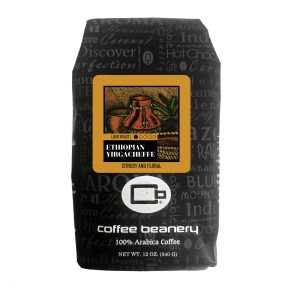
Coffee Beanery Ethiopian Yirgacheffe Specialty Coffee
Jasmine and blueberry at maximum acidity with real sweetness underneath, but the 1/5 body means a loose extraction leaves nothing to fall back on.
Affiliate link. We earn a commission at no extra cost to you.
Profile
Tasting Notes
- Body sits at 1/5. There is no structural weight here. What carries the cup is acidity and sweetness, and both have to pull their weight from first contact.
- Jasmine and citrus lead, vivid and linear. The 5/5 acidity governs the entire arc of the cup.
- Blueberry and a faint winy note emerge as the cup cools, most distinct in slower brews and in the second half of the drink.
- Sweetness at 4/5 lands in the mid-palate like restrained honey. It fades without turning cloying.
- Bitterness at 2/5 disappears in pour over. The finish is fast.
Who It’s For
This suits the pour over drinker who values Yirgacheffe's floral-citrus profile over a roaster's sourcing story. The cup delivers what the origin promises; the lot documentation does not come with it.
The winy fermentation note that surfaces as the cup cools is a quality-control variance, not a style choice. Drinkers who find it in a first bag will likely find it in the next one, and the absent body leaves imprecise brewing with nothing to absorb the impact.
Full review
Pour over is the right home for this. The 5/5 acidity and 4/5 sweetness need a controlled extraction to resolve properly, and a long, slow draw-down gives the jasmine and citrus time to separate before the acidity peaks. Grind medium-fine and run water in the 195 to 198°F range. Take your time with the pour. The blueberry note develops in the mid-cup and is most distinct at a 3:30 to 4-minute draw-down. At 1/5 body, a too-coarse grind or water running hot will spike the acidity without sweetness to land against it.
AeroPress compresses the profile into something tighter. At medium grind with two to three minutes of steep, citrus comes forward and the deeper berry note pulls back. The cup is brighter and more linear than pour over, still clean, and useful when you want the acidity forward without a long-form brew. Drip machines work with one condition: the brewer needs to reach 195°F to develop the florals. An underpowered drip unit running cooler will underextract and flatten everything into a generic light-roast cup. That temperature floor is the practical risk in automatic brewing here, and it is not a small one if your machine runs cool.
Yirgacheffe's reputation starts in geography. The growing zone sits above 1,700 meters, where cool temperatures and slow cherry development over months rather than weeks concentrate floral and citric compounds in the green bean before roasting begins. A washed process reinforces the effect by stripping the fruit skin and mucilage before drying, removing the fermented-fruit layer a natural process would add and leaving the bean's inherent character in sharper focus. The jasmine and citrus in this cup are the origin's own. The winy note that surfaces as the cup cools is a trace of fermentation from the processing stage, present in the community data and confirmed in the profile. Some drinkers will read it as berry complexity. Others will flag it as a defect.
Compare the flavor profile here to Speckled Ax's Ethiopia Suke Quto Honey, and the processing difference shapes everything. A honey-process Ethiopian retains mucilage through drying, which adds body and integrates sweetness and fruit into a rounder, more forgiving cup. The washed Yirgacheffe here is sharper, more linear. Against Intelligentsia's House Blend on performance, the contrast is structural. The House Blend was designed to deliver consistent results across variable extraction conditions and grinder settings. This single origin was built for floral clarity on a controlled path. In a well-managed pour over, it outperforms the House Blend on florals and acidity. In any context requiring a forgiving extraction margin, the House Blend wins.
At $18.49 for 12 ounces, the price is $1.54 per ounce. For a specialty-positioned washed light roast Yirgacheffe from a US retailer with national distribution, that is competitive. Coffee Beanery does not publish the producer name, cooperative, or lot grade for this coffee. You are buying a documented terroir from a brand with decades of reach, not a traceable supply chain. The cup is genuine: the acidity and floral character are real Yirgacheffe performance, not a generic light-roast imitation. The 30-day price history has one data point: $18.49, with no movement and no discount window to time.
Keep pulling the thread: Light roast guide, Ethiopia, Yirgacheffe origin guide, and more from Coffee Beanery.
Price & History
Current price is $18.49 with a 30-day average, high, and low all at $18.49: one data check, no movement. At $1.54 per ounce for a genuine washed Yirgacheffe, the price is fair and there is no discount to chase. Buy it if the profile fits your setup.
► Show price history (26 days)
| Date | Price | Per oz |
|---|---|---|
| Jul 26, 2026 | $18.49 | $1.541 |
| Jul 25, 2026 | $18.49 | $1.541 |
| Jul 24, 2026 | $18.49 | $1.541 |
| Jul 23, 2026 | $18.49 | $1.541 |
| Jul 22, 2026 | $18.49 | $1.541 |
| Jul 21, 2026 | $18.49 | $1.541 |
| Jul 20, 2026 | $18.49 | $1.541 |
| Jul 19, 2026 | $18.49 | $1.541 |
| Jul 18, 2026 | $18.49 | $1.541 |
| Jul 17, 2026 | $18.49 | $1.541 |
| Jul 15, 2026 | $18.49 | $1.541 |
| Jul 14, 2026 | $18.49 | $1.541 |
| Jul 13, 2026 | $18.49 | $1.541 |
| Jul 12, 2026 | $18.49 | $1.541 |
| Jul 11, 2026 | $18.49 | $1.541 |
| Jul 10, 2026 | $18.49 | $1.541 |
| Jul 9, 2026 | $18.49 | $1.541 |
| Jul 7, 2026 | $18.49 | $1.541 |
| Jul 5, 2026 | $18.49 | $1.541 |
| Jul 4, 2026 | $18.49 | $1.541 |
| Jul 1, 2026 | $18.49 | $1.541 |
| Jun 27, 2026 | $18.49 | $1.541 |
| Jun 25, 2026 | $18.49 | $1.541 |
| Jun 24, 2026 | $18.49 | $1.541 |
| Jun 22, 2026 | $18.49 | $1.541 |
| Jun 21, 2026 | $18.49 | $1.541 |
Rating
FAQ
What does Coffee Beanery Ethiopian Yirgacheffe Specialty Coffee taste like?
Body sits at 1/5. There is no structural weight here. What carries the cup is acidity and sweetness, and both have to pull their weight from first contact. Jasmine and citrus lead, vivid and linear. The 5/5 acidity governs the entire arc of the cup. Blueberry and a faint winy note emerge as the cup cools, most distinct in slower brews and in the second half of the drink.
Who is Coffee Beanery Ethiopian Yirgacheffe Specialty Coffee best for?
This suits the pour over drinker who values Yirgacheffe's floral-citrus profile over a roaster's sourcing story. The cup delivers what the origin promises; the lot documentation does not come with it.
Who should skip Coffee Beanery Ethiopian Yirgacheffe Specialty Coffee?
The winy fermentation note that surfaces as the cup cools is a quality-control variance, not a style choice. Drinkers who find it in a first bag will likely find it in the next one, and the absent body leaves imprecise brewing with nothing to absorb the impact.